
Space Operations Explained by Kids
Written for Kids. Surprisingly Useful for Adults. 🌍
Before the Rocket Arrives
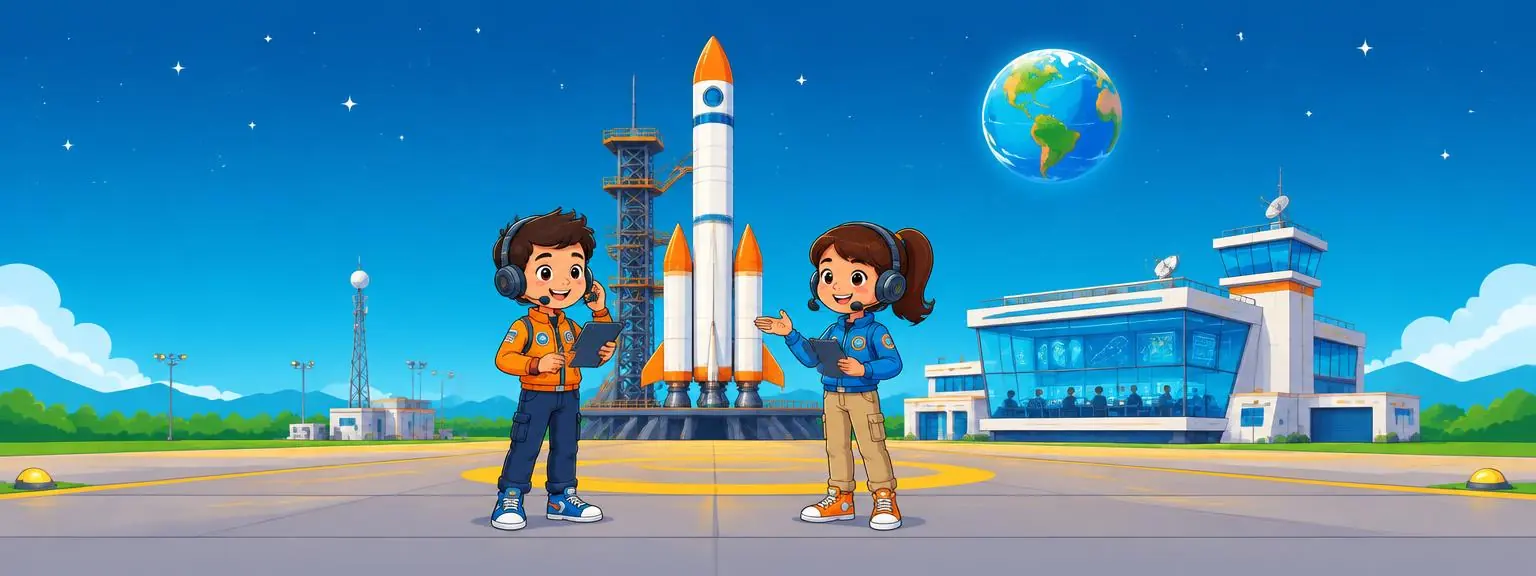
A space mission begins long before a rocket reaches the launchpad. Teams spend months or even years preparing everything for launch.
The mission is being prepared long before anyone presses the launch button.
- 01 Mission Planning: scientists and engineers decide the goal, destination, and duration
- 02 Rocket Preparation: engineers assemble the rocket and test every system
- 03 Payload Preparation: the spacecraft, satellite, telescope, or instruments are attached
- 04 Launch Site: weather teams, ground crews, and controllers prepare everything
When the Rocket Launches
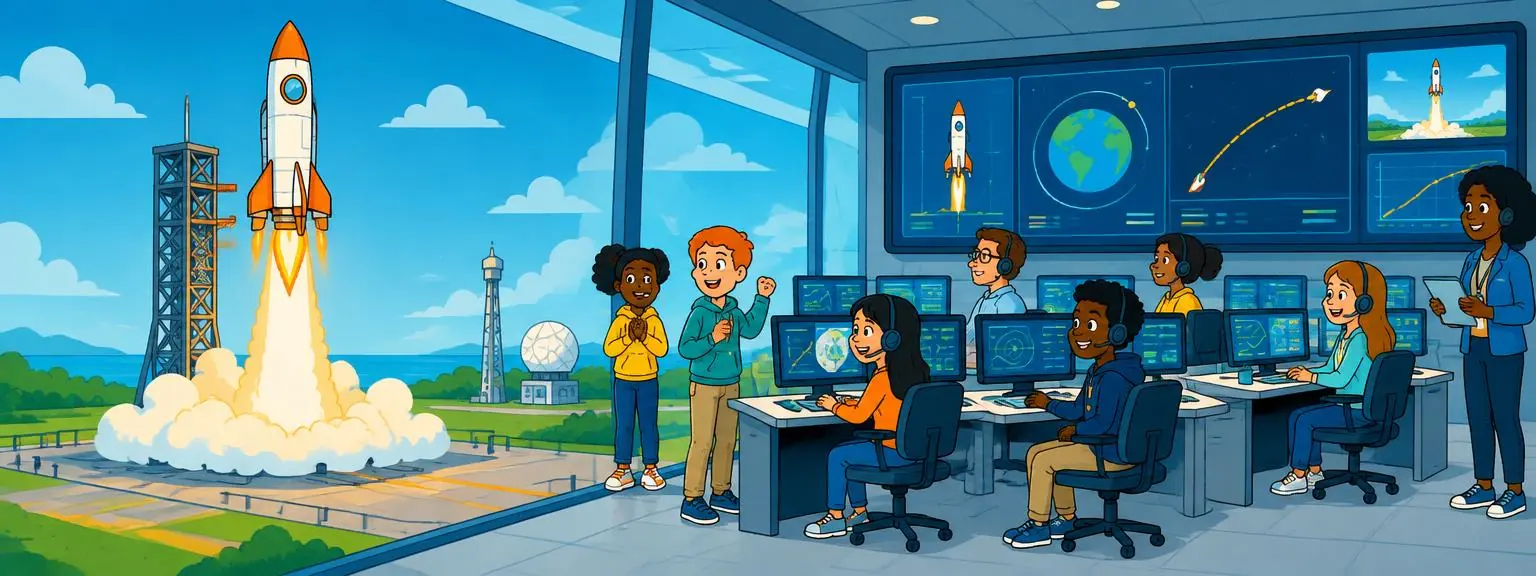
When everything is ready, the countdown reaches zero. Powerful engines fire and the rocket begins its journey into space.
- Ignition 🔥: rocket engines produce enormous thrust
- Liftoff 🚀: the rocket leaves the launchpad and climbs
- Max Q 💨: the rocket crosses the greatest atmospheric pressure
- Stage Separation: empty rocket sections separate to reduce weight
- Into Space 🌌: the spacecraft continues toward its orbit or destination
What Happens After Launch?
Reaching space is only the beginning. The spacecraft must find its correct path and start operating.
- Orbit Insertion: an engine burn places the spacecraft in the correct orbit
- Solar Panels: panels unfold and make electricity from sunlight
- Communication: signals and information travel back to Earth
- Systems Check: controllers inspect computers, power, temperature, fuel, and other systems
Mission Control and Talking to Space
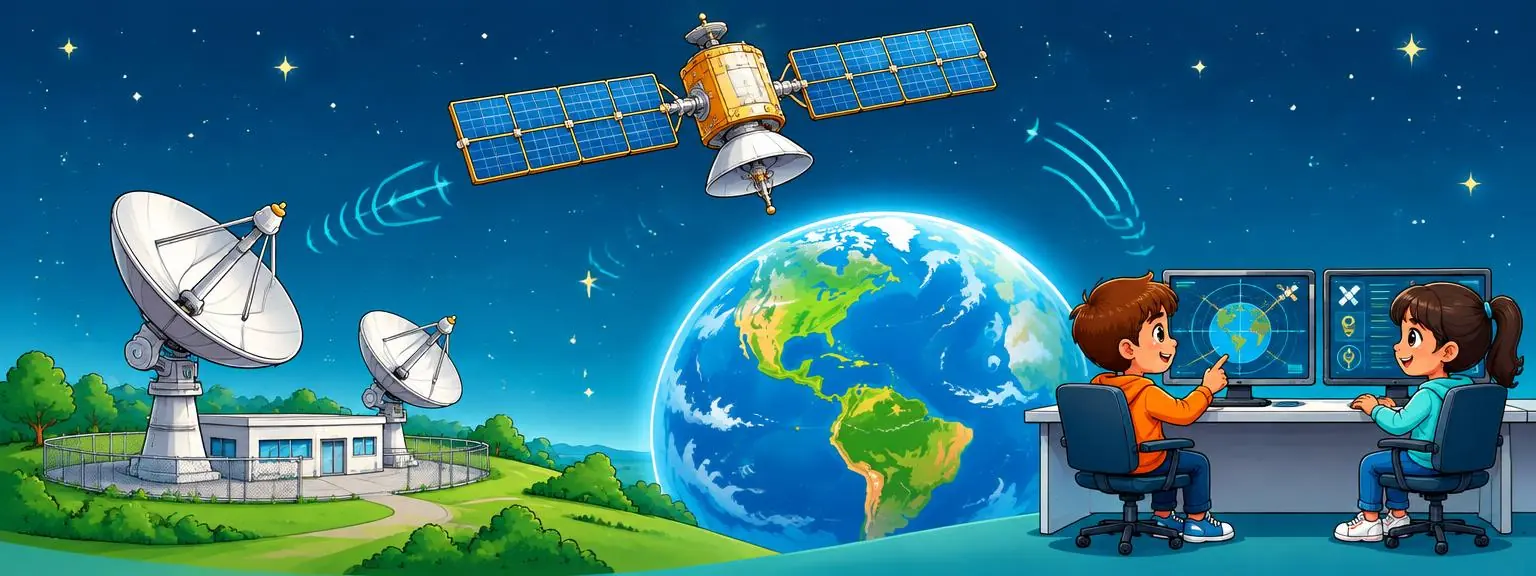
Thousands or millions of kilometres away, teams on Earth continue operating the mission.
Signals can take minutes or even hours to travel. Mission control is the spacecraft's team on Earth.
Flight Controllers
Monitor the spacecraft and send commands
Engineers
Watch systems and solve technical problems
Scientists
Study information collected by instruments
Communications Team
Receives signals and sends instructions
Mission Director
Coordinates teams during important moments
Ground Station
Huge antennas send and receive radio signals
- Uplink: information sent from Earth
- Downlink: information sent back to Earth
- Telemetry: information about spacecraft health
- Commands: instructions telling the spacecraft what to do
How Does a Spacecraft Know Where It Is?
Space is enormous, so spacecraft need very careful navigation.
Even a tiny change early in a journey can make a huge difference later.
- Star Trackers ⭐: cameras identify stars to understand direction
- Gyroscopes: measure movement and rotation
- Ground Tracking: antennas track position and movement
- Navigation Computers: combine information to calculate the route
- Course Correction: small engine burns adjust the path
Powering a Spacecraft
Spacecraft need electricity for computers, cameras, heaters, radios, and scientific instruments.
Space can be extremely hot in sunlight and extremely cold in darkness.
- Solar Panels ☀️: turn sunlight into electricity
- Batteries 🔋: store power when sunlight is unavailable
- Power Control: sends electricity where it is needed
- Thermal Control 🌡️: prevents equipment becoming too hot or cold
Satellites and Missions Beyond Earth
Many spacecraft orbit Earth, while others travel to the Moon, planets, asteroids, and deep space.
The farther a spacecraft travels, the longer communication with Earth can take.
Weather Satellites 🌦️
Watch clouds and storms
Communication Satellites 📡
Transmit television, internet, and calls
Navigation Satellites 🧭
Help calculate positions and directions
Earth Observation 🌍
Collect information about our planet
Moon Missions 🌕
Orbit, land on, or explore the Moon
Mars Missions 🔴
Rovers and orbiters study Mars
Asteroid Missions ☄️
Study ancient Solar System rocks
Deep Space Missions 🌌
Travel billions of kilometres from Earth
Robots in Space
Robots explore dangerous places before humans ever visit them.
- Rovers: wheeled robots that explore surfaces
- Robotic Arms: move equipment and instruments
- Orbiters: travel around a world
- Landers: reach and operate on a surface
- Probes: investigate places in space
Astronauts at Work
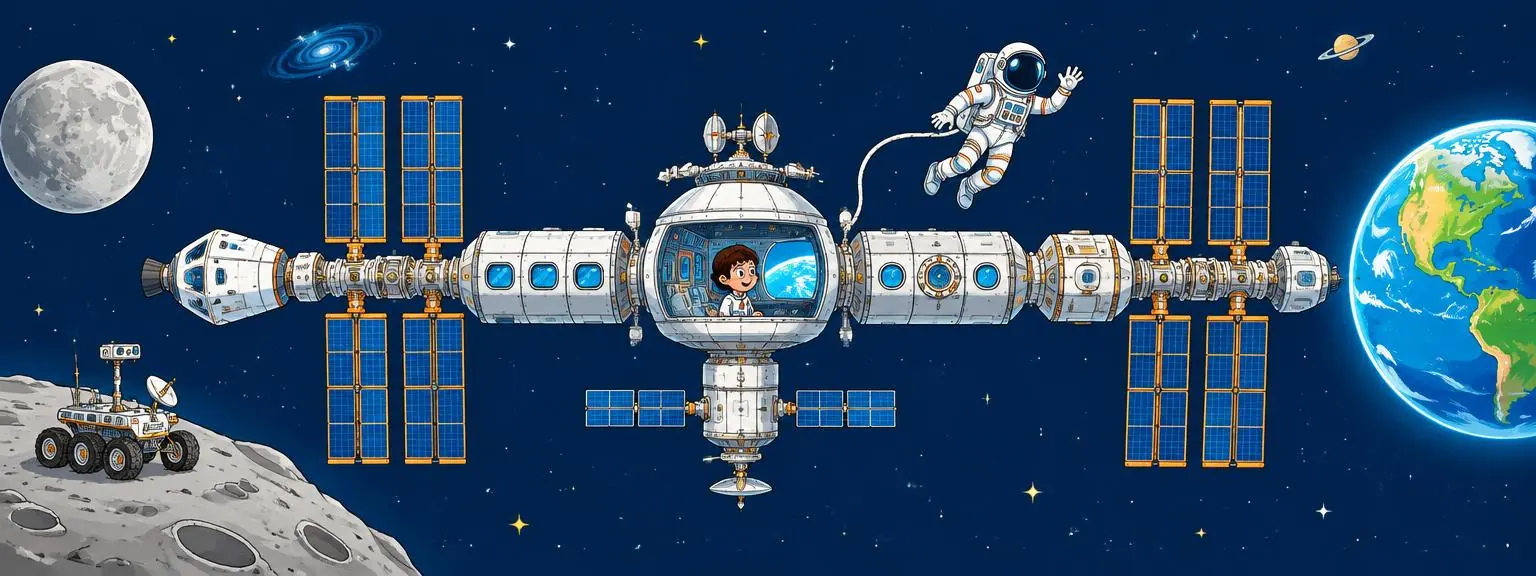
Astronauts are scientists, engineers, pilots, and explorers all at once.
Every spacewalk is planned and checked carefully before the outer hatch opens.
Science 🔬
Perform experiments
Maintenance 🔧
Repair equipment
Spacewalks 🧑🚀
Work outside in a spacesuit
Exercise 🏃
Protect muscles and bones
Suit Check
Test oxygen, pressure, cooling, and communication
Airlock
Use a chamber between spacecraft and space
Safety Tether
Stay connected to the spacecraft
Mission Tasks
Complete planned repairs or experiments
Living in Space
A spacecraft or space station is a tiny home and laboratory travelling through space.
- Sleeping 😴: bags attach to walls or surfaces
- Food 🍎: special meals work in microgravity
- Water 💧: water is carefully recycled
- Air 🌬️: systems add oxygen and remove carbon dioxide
- Exercise 🏃♂️: equipment helps astronauts stay healthy
Resupply Missions
Space stations depend on a constant supply chain between Earth and space.
- Cargo Spacecraft: carry food, experiments, equipment, and spare parts
- Docking: the spacecraft approaches and connects
- Unloading: astronauts move supplies into the station
- Waste: rubbish and unwanted equipment leave on departing spacecraft
Returning to Earth
Returning safely can be just as difficult as launching.
The mission is not finished until the spacecraft and crew are safely home.
- Departure: the spacecraft separates or begins its journey home
- Deorbit Burn: engines slow the spacecraft toward Earth
- Reentry 🔥: the spacecraft enters the atmosphere at high speed
- Heat Shield: special materials protect it from enormous heat
- Parachutes 🪂: slow some spacecraft before landing
- Splashdown 🌊: some spacecraft land in the ocean
Where Space Missions Are Controlled
A space mission is a giant team effort connecting Earth with space.
- Launch Site 🚀: where rockets begin
- Mission Control 🖥️: where teams operate spacecraft
- Tracking Stations 📡: where antennas communicate
- Research Centres 🔬: where scientists study information
- Astronaut Training Centres 👨🚀: where crews practise missions and emergencies
Big Space Missions
- Human Spaceflight 👨🚀: people live, work, and experiment in space
- Satellite Missions 🛰️: support communication, navigation, weather, and observation
- Planetary Missions 🪐: explore planets, moons, asteroids, and comets
- Space Telescopes 🔭: observe distant stars and galaxies
- Space Stations 🏠: let astronauts live and work for long periods
Why Space Operations Are So Difficult
Space missions must be designed to work even when things go wrong.
- Distance: spacecraft can travel billions of kilometres
- Communication Delay: signals need time to travel
- Extreme Temperatures: equipment must survive huge changes
- Radiation ☢️: can damage electronics and living cells
- No Easy Repairs: distant spacecraft may be impossible to reach
Space Mission Timelines
Some missions last days. Others continue for decades.
Some spacecraft keep exploring long after their original mission plans.
- Launch: the rocket carries the spacecraft away
- Cruise: the spacecraft travels toward its destination
- Arrival: it reaches its target
- Operations: instruments collect and send information
- Extended Mission: work continues while systems remain healthy
Fun Space Operations Facts
Speed
A spacecraft in low Earth orbit travels around 28,000 kilometres per hour.
Distance
The Moon is about 384,000 kilometres from Earth.
Signals
Radio signals travel at the speed of light.
Microgravity
Astronauts float because they and their spacecraft continuously fall around Earth.
Precision
Space missions need extremely accurate navigation.
Solar Power
Many spacecraft use sunlight to make electricity.
Quick Summary
Planning and Launch
Teams prepare the mission, rocket, payload, and launch site.
Orbit and Operations
Spacecraft navigate, generate power, and complete their work.
Mission Control
Earth teams communicate, monitor systems, and solve problems.
Return to Earth
Careful deorbit, reentry, and landing complete the mission.
Space Operations Dictionary
Mission Control
The team and centre on Earth that operates a mission
Payload
Useful equipment carried by a rocket
Orbit
The curved path around a planet, moon, or another object
Telemetry
Data showing how spacecraft systems are working
Uplink
Information sent from Earth to a spacecraft
Downlink
Information sent from a spacecraft to Earth
Ground Station
Antennas on Earth that communicate with spacecraft
Docking
When two spacecraft carefully connect
Deorbit
A manoeuvre that sends a spacecraft toward Earth
Reentry
Travelling back through Earth's atmosphere
Heat Shield
Material that protects a spacecraft during reentry
Thrust
The pushing force made by a rocket engine
Orbit Insertion
A manoeuvre that places a spacecraft into orbit
Course Correction
A small change to a spacecraft's path
Microgravity
An environment where objects appear almost weightless
Rover
A robotic vehicle that moves across another world
Orbiter
A spacecraft that travels around another object
Lander
A spacecraft designed to land on another world
Probe
A spacecraft sent to collect information
Spacewalk
When an astronaut works outside a spacecraft
Airlock
A chamber for moving safely between a spacecraft and space
Solar Panel
A device that turns sunlight into electricity
Launch Window
The period when a rocket can reach its destination
Trajectory
The path a spacecraft follows
Gravity Assist
Using a world's gravity to change speed or direction
Flight Controller
A specialist who monitors part of a mission
You Are Now a Space Operations Expert! 🚀
Keep learning, keep exploring, and stay curious about how humans operate in space! 🌍🚀