
The AI Challenge Lab
Can AI Teach a Seven Year Old a GCSE Subject?
Challenge 1: Make a Difficult Question Simple
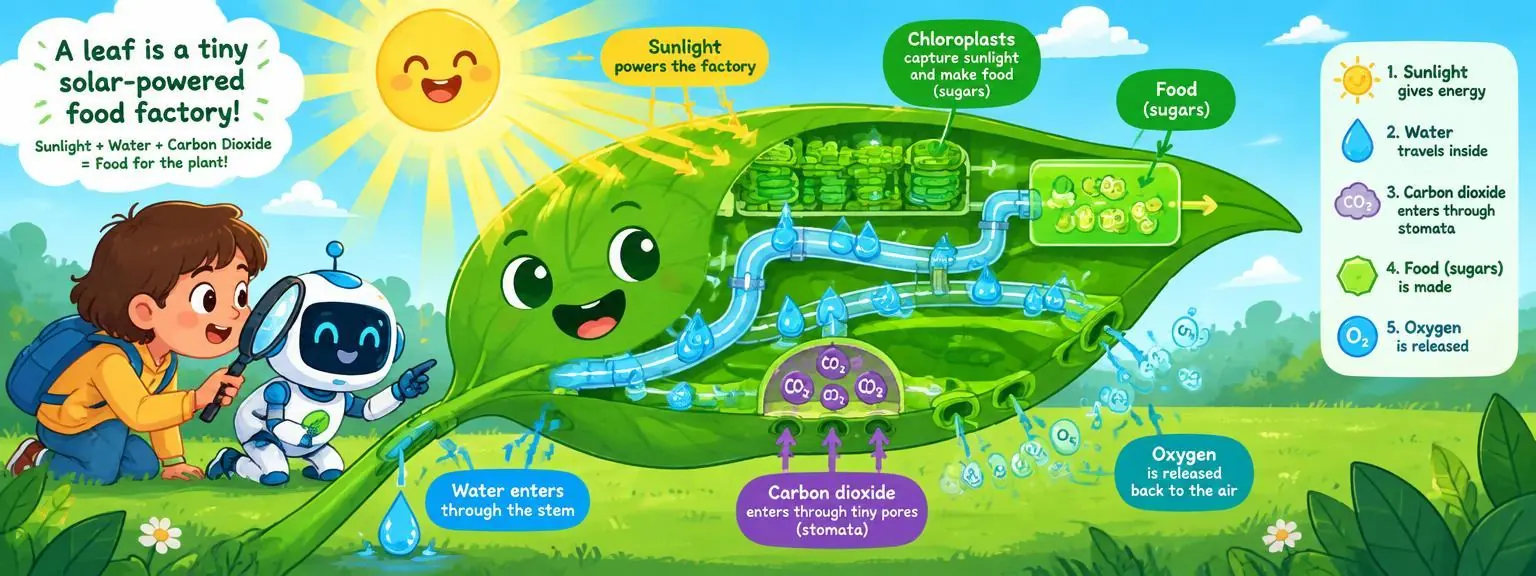
GCSE Biology: How a Leaf Works. A GCSE question asks: “Explain how the structure of a leaf is adapted for photosynthesis.” Big words like structure, adapted and photosynthesis can feel scary. But AI can explain them in a way a seven year old understands. Think of a leaf as a tiny solar-powered food factory!
🌞 Wide Shape: collects as much sunlight as possible: like holding out a big flat tray to catch rain.
🌬️ Thin Body: gases can move in and out easily: like a very thin sponge.
💚 Chlorophyll: the green stuff that captures light energy: like a battery that charges from the sun.
🔵 Tiny Tubes: carry water in and sugar out: like little pipes inside the leaf.
Try it: ask AI to explain the same idea to an 11 year old, then at full GCSE level. Compare what changes!
Challenge 2: Turn Algebra into a Story
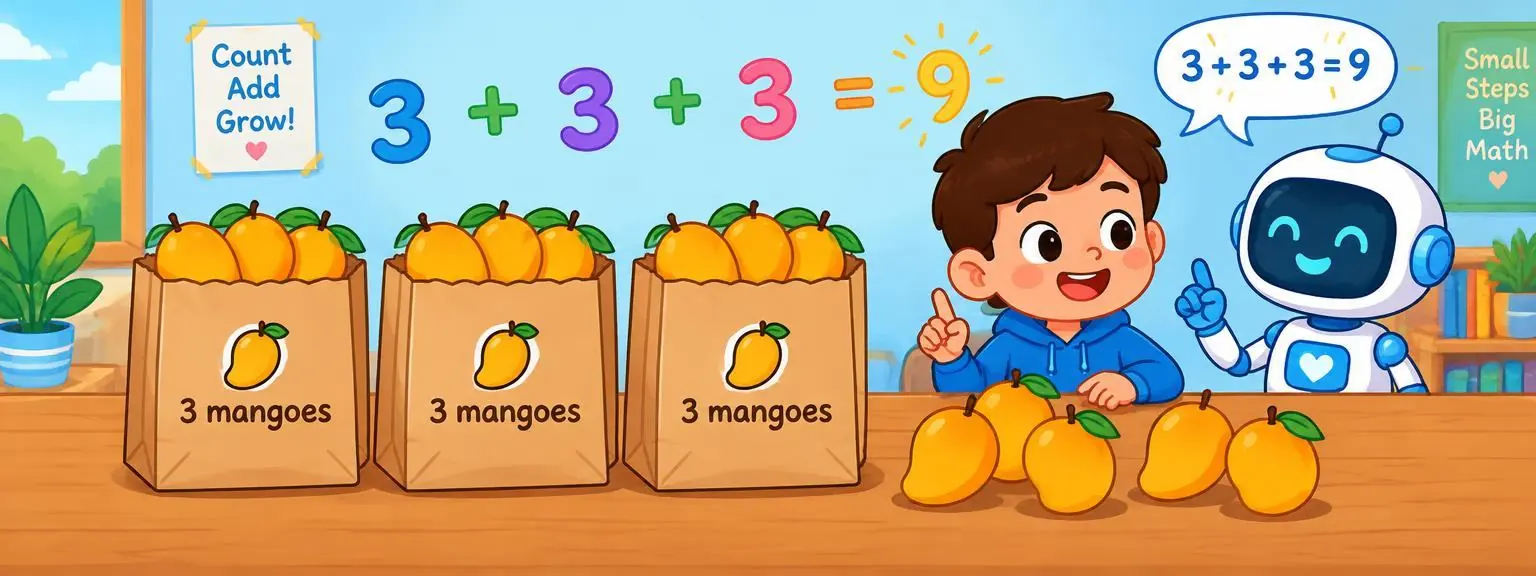
GCSE Maths: Solving 3x + 5 = 20. Instead of asking AI for the answer straight away, say: “Turn this algebra question into a story involving three identical bags of mangoes.” AI might explain it like this: there are three bags with the same number of mangoes inside, plus five extra mangoes sitting on the table. Altogether there are 20 mangoes.
Step 1: remove the 5 extra mangoes. 20 − 5 = 15.
Step 2: share 15 mangoes equally between 3 bags. 15 ÷ 3 = 5.
Step 3: each bag holds 5 mangoes. So x = 5!
Take it further: ask AI to create a harder algebra question using boxes of footballs, and solve it one step at a time.
Challenge 3: Make the Invisible Visible
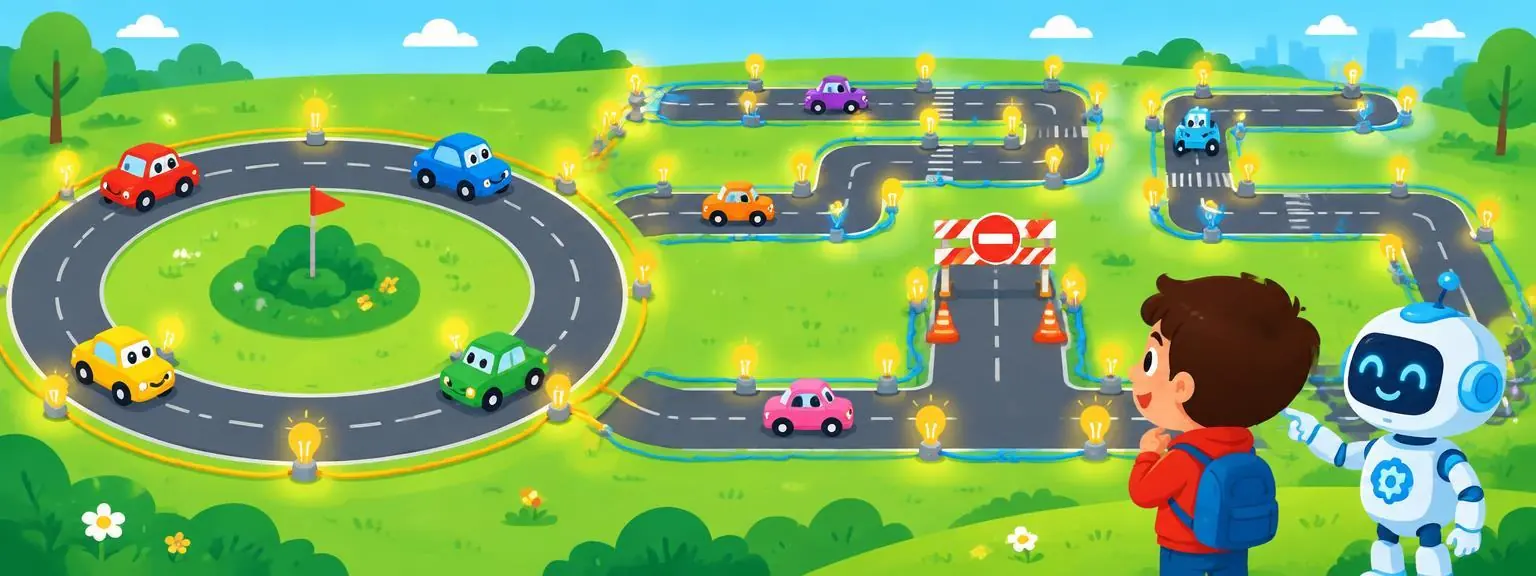
GCSE Physics: Series and Parallel Circuits. Ask AI: “Explain series and parallel circuits to a seven year old using roads and cars.”
This comparison is not a complete scientific explanation but it creates a picture in your mind. Now ask AI: “Where does the road comparison stop being scientifically accurate?”
🔴 Series Circuit: one circular road. If any part is blocked, every car must stop. All lights go out!
🟢 Parallel Circuit: several connected roads. If one route is blocked, cars use another route. Some lights stay on!
No comparison is perfect. Learning where it breaks down is part of the science!
Challenge 4: Travel Inside a Difficult Subject
GCSE Geography: How an Oxbow Lake Forms. Ask AI: “Take me on an imaginary journey as a drop of water travelling through a river. Explain how a meander eventually becomes an oxbow lake. Write for a seven year old.” Instead of reading a definition, you can imagine being carried through the water: bending around curves, wearing away the banks, until the river cuts through and leaves behind a curved lake!
- 01: River bends (meander)
- 02: Outside bank wears away faster
- 03: Bend grows into a loop
- 04: River cuts through the loop
- 05: Loop is sealed off → oxbow lake!
Then ask: “Show the same process in five numbered stages using correct GCSE vocabulary.” The story helps you picture it; the stages give you the exam words.
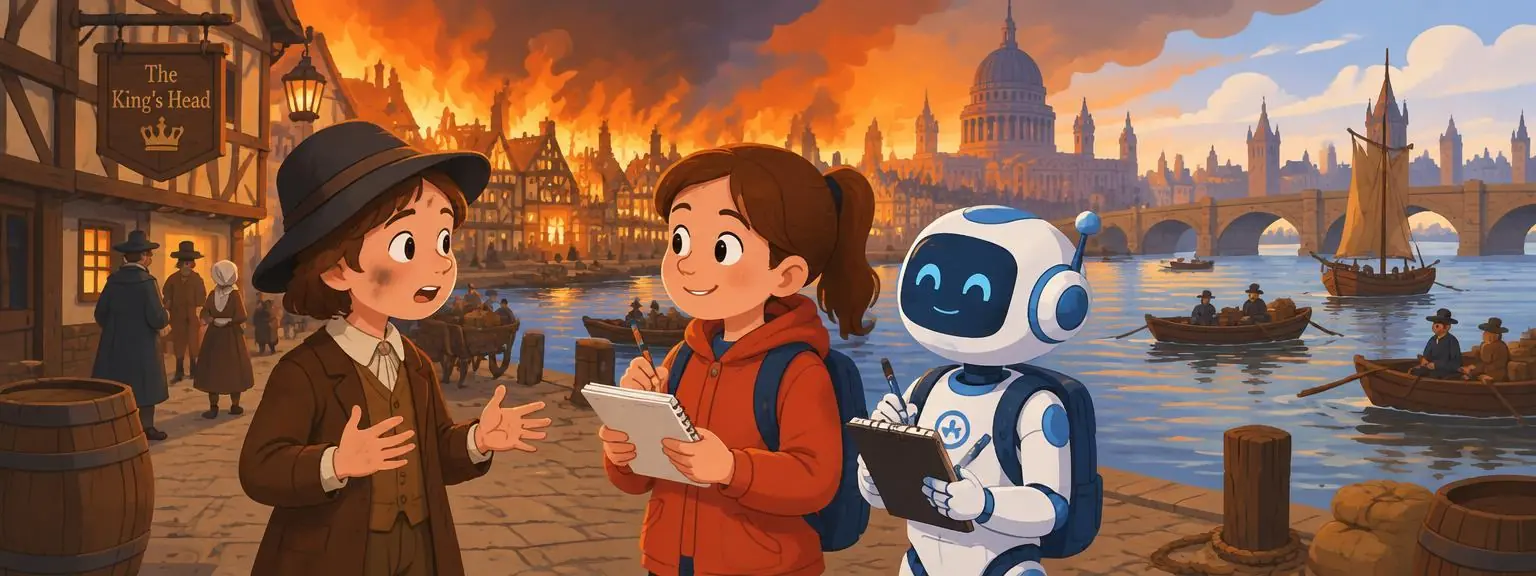
Challenge 5: Interview Someone from History
History: The Great Fire of London, 1666. Instead of asking AI to list facts, turn it into a conversation. Try: “Pretend you are a child living in London during the Great Fire of 1666. I am going to interview you. Describe what you can see, hear and smell but clearly tell me which parts are known facts and which parts are imagined.”
🔥 What you might hear: crackling flames, shouts in the streets, the Thames churning with boats fleeing the city.
⚠️ Important reminder: AI was NOT at the Great Fire. It creates a character using historical information and imagination. Always check the facts!
After the interview, ask: “Give me reliable sources I could use to check the historical facts in this conversation.” Then check those sources actually exist!
Challenge 6: Move Between Ages
Chemistry: Why Does Temperature Speed Up Reactions? Ask AI to explain the same idea at four different levels. Watch what changes!
- 1: Age 7: children moving around a playground: the faster they move, the more they bump into each other!
- 2: Age 11: more heat means particles move faster and collide more often.
- 3: GCSE: using the words particles, energy, collision and reaction rate.
- 4: University: activation energy, Arrhenius equation, distribution of molecular speeds.
Reverse it: ask the seven year old to explain the simple version back to AI. Then ask AI to identify what the child understood and what needs more explanation.
Challenge 7: Make AI Teach Without Answering
Maths: Average Speed. Give AI this question: “A car travels 150 kilometres in three hours. What is its average speed?” But do NOT ask AI to solve it. Instead say: “Teach this problem to a seven year old. Ask one question at a time. Give clues if needed, but do not reveal the answer until the child has attempted it.”
💬 AI asks first: “If the car travelled the same distance in each hour, what could we do with 150?”
💬 If you get it wrong, add: “If I make a mistake, ask me to explain my thinking before giving me a clue.” This turns a wrong answer into a learning opportunity!
Challenge 8: Find the Deliberate Mistake
Science: Why Do We Have Seasons? Tell AI: “Explain why we have seasons, but include one believable mistake. Do not reveal the mistake until I have tried to find it.” Read the explanation carefully. Then check it against a reliable science source.
❌ The Common Mistake: a common incorrect idea: summer happens because Earth is closer to the Sun.
✅ The Real Answer: seasons are mainly caused by the tilt of Earth's axis, not how close Earth is to the Sun.
After you find the mistake, ask: “Explain why that mistake might sound believable.” This challenge teaches you never to accept every polished answer as true!
Challenge 9: Improve a Real Piece of Work
History: The Printing Press. Write your own short answer to: “Why was the invention of the printing press important?” Then give your answer to AI and say: “This is my own answer. Do not rewrite it. Ask me three questions that will help me add more detail, evidence and explanation.”
📝 Improve your answer: use the three questions to make your writing stronger yourself.
📊 Then ask AI: “Compare my improved answer with my first attempt. Explain what became stronger.”
🎯 The goal: the purpose is not to make AI write better work. The purpose is to help you become a better writer.
Challenge 10: Create Something New from What You Learned
Pick a GCSE topic then make something amazing! Ask AI to help you turn what you've learned into something creative. Say: “Help me design a board game that teaches players how a leaf performs photosynthesis. Ask me questions about the rules, challenges and winning conditions. Do not design the entire game for me.”
- 🎲 Board Game
- 🎨 Comic Strip
- 📺 Quiz Show
- 📰 News Report
- 🎭 Short Play
- 🏛️ Museum Exhibition
You are no longer simply learning the information. You are using it to make something new.
🤖 Fun AI Challenge Lab Facts
GCSE questions are for 15 to 16 year olds
But AI can explain them in a way that a 7 year old can begin to understand without making the science wrong!
Mango maths works!
Turning 3x + 5 = 20 into a story about bags of mangoes makes the algebra feel like a real puzzle you can picture.
Roads and cars teach circuits
A blocked road is like a broken wire in a series circuit: every car (electron) stops moving!
The Great Fire trap
AI can create a vivid interview about the Great Fire of 1666 but it wasn't there. Always check your facts!
Seasons are NOT caused by distance
Earth's axis tilts: that is what causes seasons. A very believable mistake that even adults often make!
📘 Quick Summary
AI can simplify, not remove
Explaining a GCSE question simply does not mean the science disappears: it means it is presented as a bridge to understanding.
Stories make maths real
Turning algebra into a mango story lets you picture the problem and solve it step by step.
All comparisons have limits
Roads and cars help explain circuits, but always ask where the comparison stops being accurate.
Always check the facts
AI can make believable mistakes. After learning from AI, always verify important facts using a trusted source.
You are the learner, not AI
The goal is to become a better thinker and writer yourself: not to let AI do your work for you.
Dictionary
Photosynthesis
How plants make food using sunlight, water and air
Adapted
Changed over time to work better in its environment
Chlorophyll
The green stuff in leaves that captures sunlight
Meander
A big curve or bend in a river
Oxbow Lake
A curved lake formed when a river bend gets cut off
Series Circuit
One path for electricity; if it breaks, everything stops
Parallel Circuit
Multiple paths for electricity; one break does not stop the rest
Reaction Rate
How quickly a chemical reaction happens
Average Speed
Total distance divided by total time taken
GCSE
Exams taken by pupils aged 15 to 16 in the UK
You Are Now an AI Challenge Lab Expert!
Keep asking great questions, keep checking the facts, and keep creating! Something being difficult does not mean you cannot begin learning it. 🚀🧠